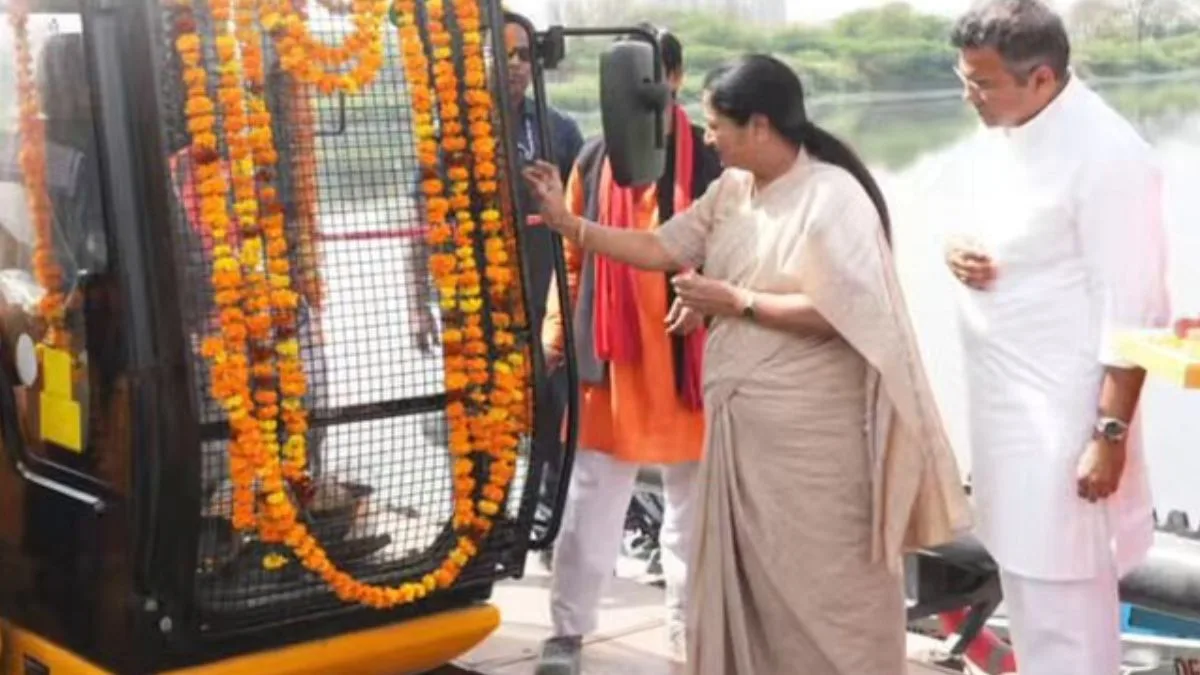
Delhi Chief Minister Rekha Gupta on Friday launched new state-of-the-art amphibious excavator machines (long boom and short boom) at Badusarai Bridge, Najafgarh Drain and Pankha Road Drain to strengthen the cleaning of the city’s drainage network.
These machines will significantly speed up and improve desilting operations, removal of garbage, and clearing of water hyacinth from the drains. The move is expected to improve water drainage capacity and help reduce waterlogging during the monsoon season.
Advertisement
On the occasion, the Chief Minister said the Delhi government is using modern technology with full commitment to clean the city’s drains and restore the Yamuna river.
The event was attended by Delhi Cabinet Ministers Shri Parvesh Sahib Singh and Shri Ashish Sood, along with senior officials of the concerned departments.
The Chief Minister noted that the Najafgarh Drain is the largest drain in Delhi and carries nearly 75 percent of the silt from the city’s drainage system.
She said that removing the massive volume of silt accumulated over the years was earlier considered an extremely difficult task.
However, with the deployment of these modern floating machines, it has now become possible. These machines can reach the middle of the drain and remove silt directly, accelerating the process of clearing long-accumulated sludge.
According to estimates, more than 10 million metric tonnes of silt have accumulated in the Najafgarh Drain. The newly deployed amphibious machines will be used to remove this massive buildup.
The Delhi government has also decided to procure more amphibious machines. One machine had already been brought earlier, while four new machines were flagged off on Friday. The remaining machines will be handed over to the department soon.
The Chief Minister added that the Delhi government is now carrying out desilting work throughout the year, instead of limiting it to the period before the monsoon. This approach aims to more effectively prevent waterlogging during the rainy season.
CM Rekha Gupta also said that under the leadership of Prime Minister Narendra Modi, the Delhi government is committed to using modern technology to clean the Yamuna and the major drains connected to it, with the goal of making the river clean and free-flowing while ensuring that Delhi becomes clean, safe and free from waterlogging.
Speaking on the occasion, Cabinet Minister Parvesh Sahib Singh said the use of advanced amphibious machines to clean the Najafgarh Drain and other connected major drains is an important step by the Delhi government.
With the help of these machines, years of accumulated silt, garbage and water hyacinth can be removed effectively, which will improve the water-carrying capacity of the drains and help reduce waterlogging during the monsoon.
He added that under the leadership of Chief Minister Rekha Gupta, the Delhi government is continuously working to clean the Yamuna and its connected drains using modern technology so that the city can develop a cleaner, safer and more efficient drainage system.
Cabinet Minister Ashish Sood said that during the Assembly elections, one of the major promises made was to beautify Pankha Road, make it clean and garbage-free, and carry out the long-pending cleaning of the Pankha Road drain. For many years, the drain had not been cleaned, causing waterlogging and foul smell during the monsoon, which created difficulties for local residents.
He said that after the government came to power, work has been continuously underway to fulfil this promise. New walls have been constructed along the drain, and within the first 100 days, the initial cleaning of the drain and beautification of a section of it have already been completed.
CM assures resolution of local issues
The Chief Minister also took note of local concerns in the area. She said issues related to high-tension power lines, water supply and other basic civic infrastructure will be discussed with the concerned departments and ministers, and decisions will be taken soon.
She added that water pipelines and sewer lines will be expanded where necessary, and Arogya Mandirs or dispensaries will also be established to strengthen healthcare facilities for residents.
Features of the amphibious excavator machines
The machines have been deployed by the Irrigation and Flood Control (I&FC) Department at several key locations including Badusarai Bridge, Kakrola, Dwarka and Uttam Nagar. The government aims to ensure that desilting of drains continues throughout the year, helping control waterlogging during the monsoon.
The short-boom amphibious machine costs around ₹1.27 crore. It has a boom length of about 6 metres, a bucket capacity of 0.20 cubic metres, and is powered by a 65 HP engine. The machine can operate even in narrow drains about 5 metres wide and is capable of moving directly inside the drain.
It also has a 2.25 cubic metre waste bin. The machine can function in dry, marshy and waterlogged conditions, and can remove silt, garbage, debris, sludge and floating materials such as water hyacinth.
The long-boom amphibious machine costs around ₹3.15 crore. It features a 15-metre boom, a 0.50 cubic metre bucket capacity, and a 135 HP engine. The machine can operate at depths of up to 9 metres and can move both inside the drain and on land.
Like the short-boom variant, it can function effectively in dry, marshy and waterlogged conditions, and is highly efficient in removing silt, garbage, debris and water hyacinth from drains.